Publish date:
May 19, 2026
Appears in:



Romania's energy and utilities sector concentrates companies with thousands of employees who work in the field every day – reading meters, carrying out interventions, checking networks. But some of these companies either use old workforce management systems or have no digital solutions at all for field operations. For Bento, an IT company listed on the AeRO market of the BVB that has been developing a field-work automation platform for over a decade, this gap has become one of its main growth directions.
"The main areas, where the biggest projects and the biggest clients are, is utilities, utilities distribution, because that is where a very large workforce of people in the field is concentrated in Romania. Companies that have a very large field workforce, companies that have thousands of people in the field, and obviously it makes sense for those companies to digitalise these operations in order to optimise them. They are essentially buying a cost saving," said Radu Scarlat, CEO and chairman of the board of directors of Bento, during the ZF Tech Day show.
The field-work digitalisation market in Romania moves in two directions, Scarlat explains. On the one hand, large enterprise companies that already have solutions but want to modernise them – old systems, from 10–15 years ago, that no longer meet requirements. On the other hand, companies that have not yet digitalised their field operations, although they have hundreds or thousands of field employees.
"There are very many companies in Romania, including very large companies, that still do not realise they need something like this. And then we bring a work of persuasion or education. We show them: look, company X is similar to you, it is just as big, and it did this," says Scarlat.
But clients are also starting to come to the company. "People are starting to realise that this solution is needed," adds Bento's CEO, referring to an increasingly visible awareness in the energy and utilities sector.
The FSM platform was designed from the outset for large enterprise companies, but it also lends itself to medium-sized companies. "We have a solution, we implemented it at very large companies, but it is actually simple, modular, configurable and we can implement it at smaller companies too," explains Scarlat, referring to the approach towards medium-sized companies, an additional segment that Bento wants to open up.
The largest project underway is a large-scale implementation for Rețele Electrice (formerly Distribuție Energie Electrică România – DEER), part of the Electrica group, started at the end of 2025. The contract, worth 32 million lei, was won through public tender by a consortium made up of Bento, as leader, and EY Romania, which provides project management and business analysis services and represents 11% of the total project activity. The IT solution – which includes both hardware and software – is to be used by over 1,200 field technicians of the energy distributor, with an implementation estimated at around 18 months, followed by seven years of support and maintenance and two years of post-support.
Bento is not on its first collaboration with the Electrica group: the company has provided a meter-reading solution for Electrica Transilvania Sud since 2012, through Adrem Automation, a system that processes around 70% of the subsidiary's billing. Another reference client of the FSM platform is Apa Nova București, part of the Veolia group, where Bento implemented an intervention-management solution in the field in 2016.
The company entered field-workforce digitalisation around 15–16 years ago, by chance. A client needed a solution for 500 people in the field, and Bento, which did not have its own product, implemented a solution from a supplier in the Czech Republic. The market back then was completely different from today's: "Back then, 15–16 years ago, there weren't really mobile devices, that is, there weren't the Android phones there are now. People didn't really even have mobile phones, especially the people who worked in the field."
The project was a success, but Bento developed its own platform, first as custom software, then as a standalone product, and 12 years after the first implementation, the original client chose to modernise and switched to the Bento solution.
In parallel with the implementation for Rețele Electrice, Bento is working on new modules of the FSM platform dedicated to medium-sized companies that are not digitalised.
"In parallel, we are also working on other improvements and modules of the platform, especially in order to be able to meet the requirements of medium clients, mid-enterprise, so to speak, that are not very digitalised otherwise," says Bento's CEO.
The company has also launched Bento LIMS, a product dedicated to water-testing laboratories, already implemented at a water company, with other implementations planned for the coming period.
Bento has a collaboration of over 10 years with Orange Business, which has evolved over time. Initially, Orange packaged Bento's products – especially the Field Service Management platform – with its own connectivity services and mobile devices, offering them to enterprise clients.
"They essentially packaged our services with their services – mobile connectivity and mobile devices, and we came with the software solution for one of their clients, which had field activity. Since then we have continued this collaboration successfully," says Scarlat. In the last two or three years, the relationship has evolved: Orange has also become a direct client of Bento, using the stock management module of the FSM platform to deliver its own services.
Bento integrates artificial intelligence algorithms into the FSM platform to optimise the allocation of orders and employees in the field, according to qualifications, positions and equipment. "We now use AI algorithms to determine, for example, how you can optimally allocate a set of orders in different locations to a set of employees who have different qualifications, tools and starting positions," explains Scarlat.
In addition to integration into products, the company uses AI as an internal tool, to make development, support and services more efficient.
The year 2025 was the first year in Bento's history in which turnover and profit declined: revenue fell to 56.3 million lei (from 84.4 million in 2024), and profit to 6.4 million lei (from 16.4 million). Scarlat attributes the decline to project postponements in the first half of the year, probably against the backdrop of the political context in Romania.
"Fortunately, not project cancellations, but postponements and delays. The second half of the year returned to normal," says Bento's CEO.
The first quarter of 2026 is "in line with expectations and with the published budget," and the results will be reported in the coming weeks. The company invests around 2 million euros per year in research and development, from profit, capital raised from investors through the BVB, and European funds, and is preparing a new European funding call.
In the medium term, Bento aims to increase its international presence with the products developed and proven in Romania. "Our ambition is for these products to be recognised internationally as being top-shelf in our niche," says Scarlat.
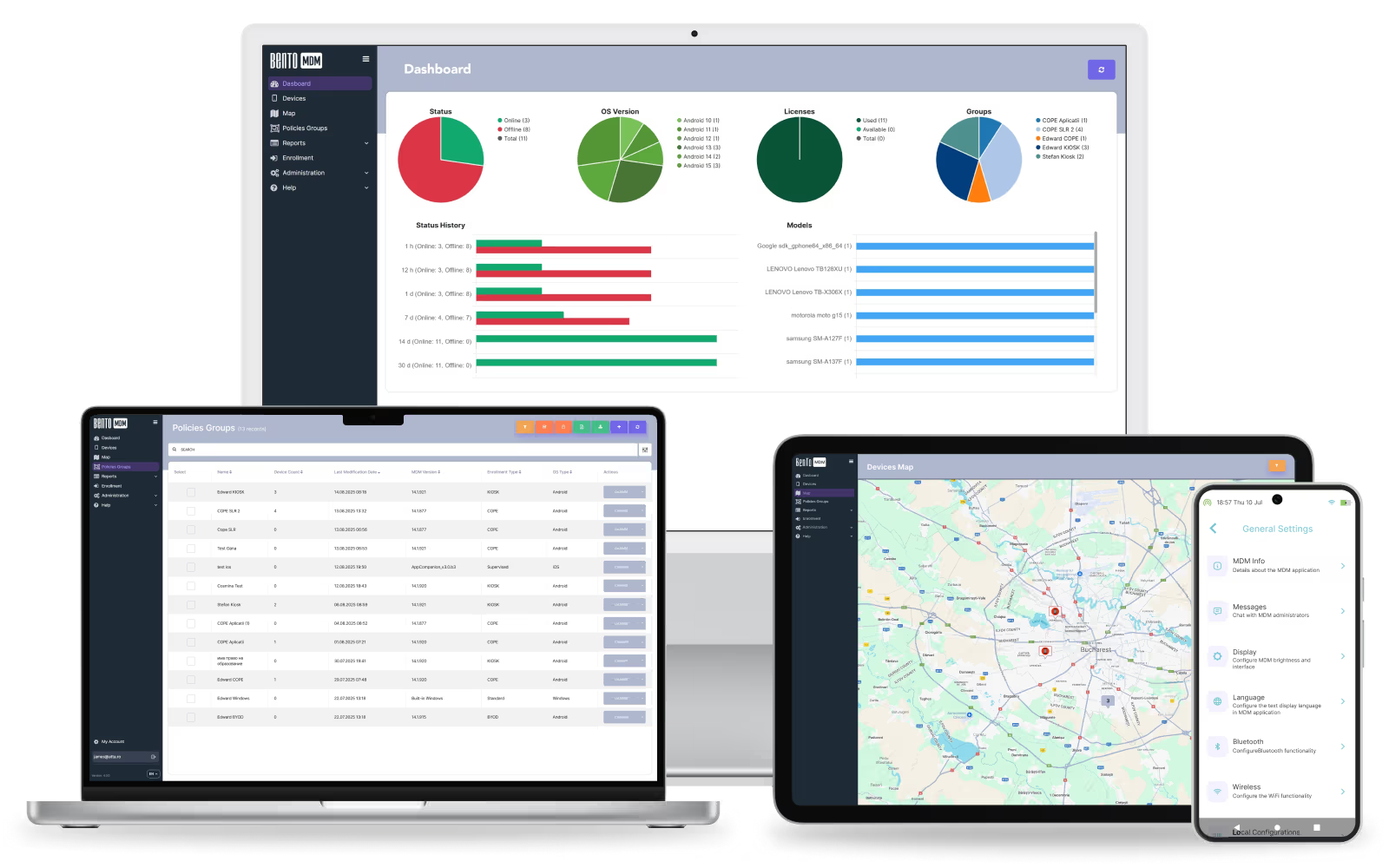
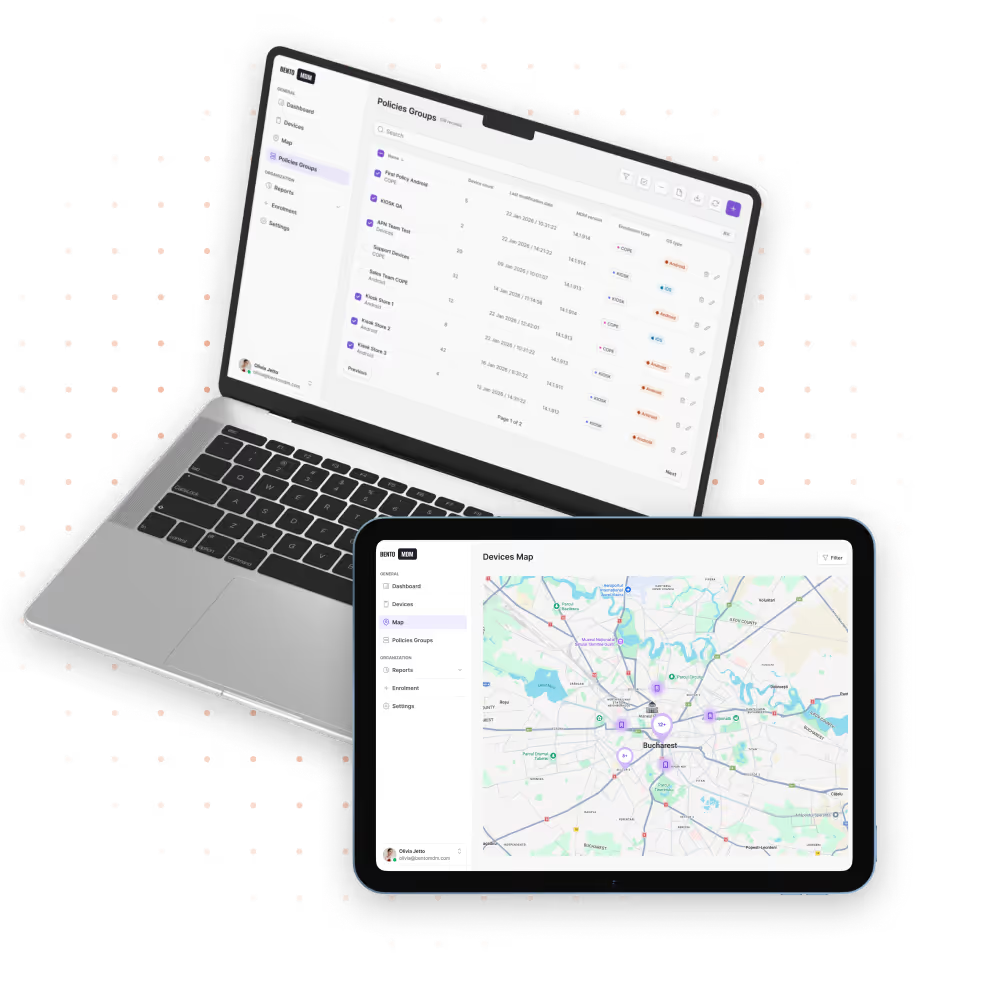
From BYOD to kiosk lockdown, Bento MDM secures and simplifies your device operations. Try it for free or book a live demo.


By Features
By Business Initiative
By OS Support